

CAREER MODE
What a career economy adds to a flight simulator
Microsoft Flight Simulator 2024 ships with a career mode. This is what a separate career economy is for, and who it is and is not worth it for.
Microsoft Flight Simulator 2024 has a career mode of its own, and it is a reasonable thing to start with. If you have flown it and found yourself wanting something with more consequence behind it, this is a description of what that looks like — written by people who build one, so read it accordingly.
The distinction worth drawing is not "better". It is that a simulator’s career mode is a set of missions, and a career economy is a job.
The difference a ladder makes
At SkyHub you start as a Cadet with an empty logbook, and rank is gated on flown hours:
- Cadet — from zero.
- Second Officer — 15 hours.
- First Officer — 40 hours.
- Senior First Officer — 90 hours.
- Captain — 160 hours.
- Line Training Captain — 280 hours.
Those are block hours you have actually flown and had recorded, and they are the only hours that count. There is no way to buy them, grind them in accelerated time, or have them credited for anything other than flying the sector.
The second half is the part that makes it an economy rather than a progress bar: hours decide when you may be promoted, and cash decides whether you can afford it. A command upgrade has a price. You need both, and neither is for sale for real money — hours come from flying, and cash is earned, lent or won.
A roster you did not choose
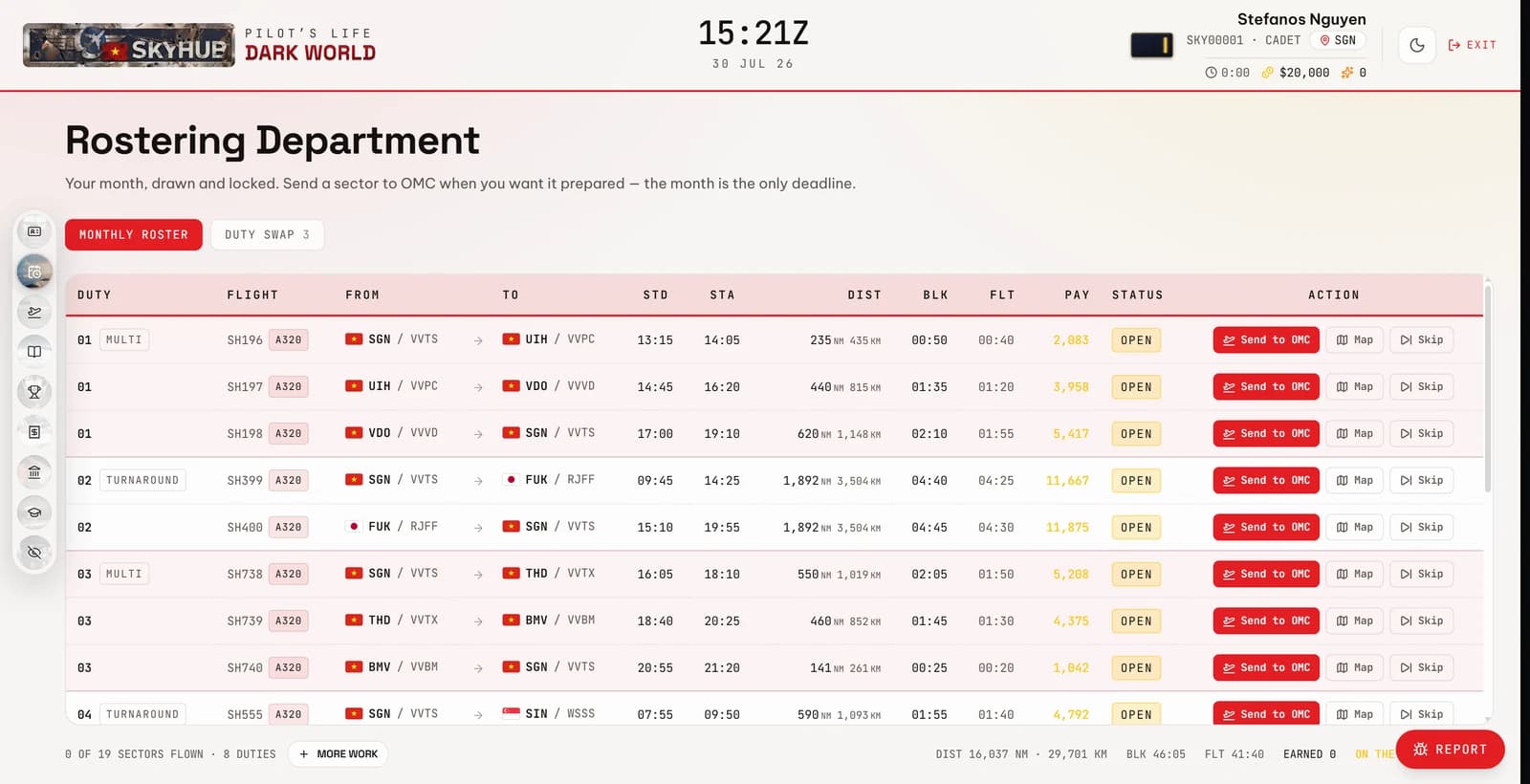
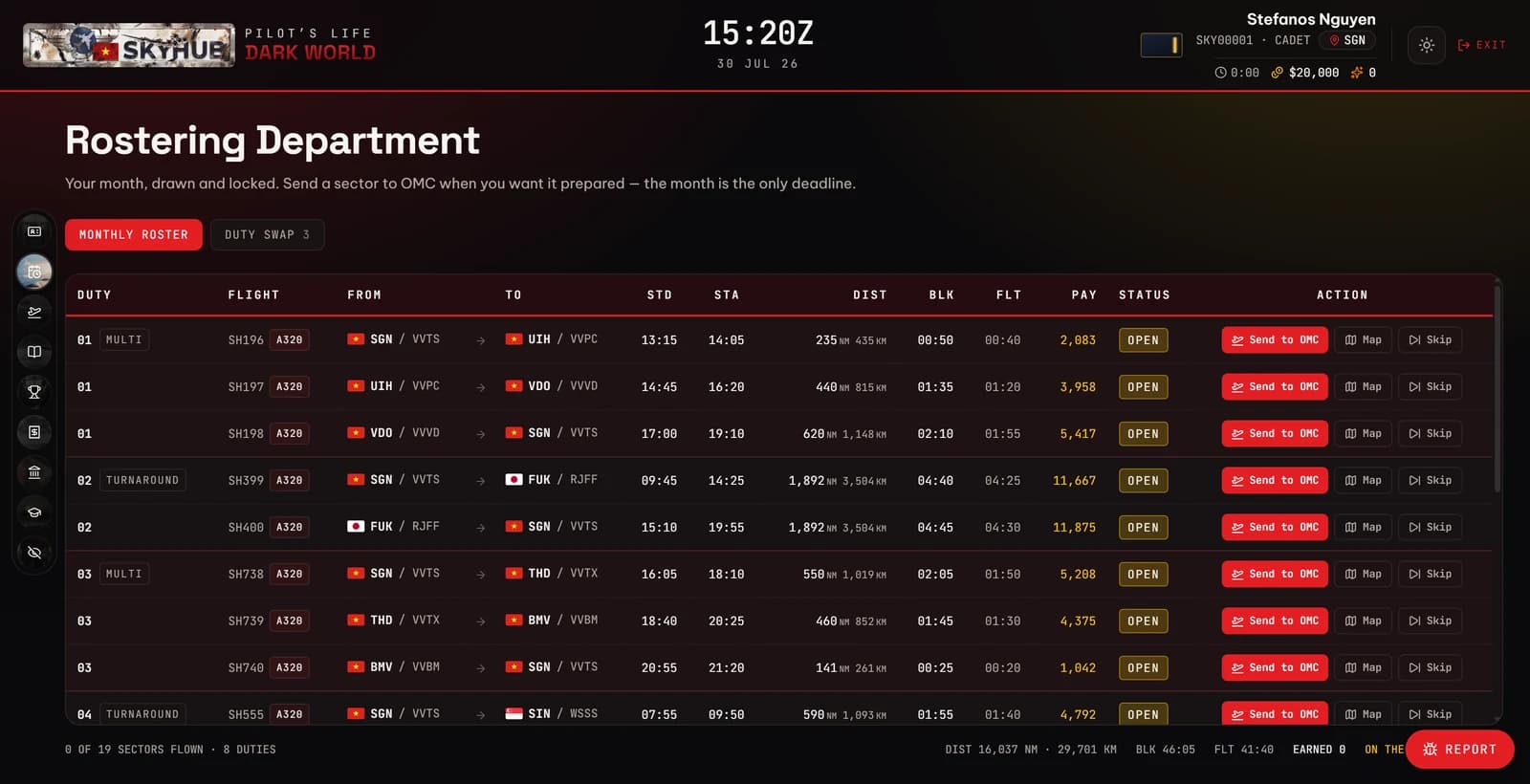
Once a month you are issued a roster: duties and sectors, drawn for you and locked. It is built to a block-hour target rather than a duty count — around fifty hours — so a month at a short-haul base and a month at a long-haul outstation are comparable pieces of work rather than accidents of what those bases happen to fly.
Fifty rather than eighty, which is what a real full-time short-haul line looks like, for a plain reason: eighty turned out to be most of a working week for someone flying this after their actual job, and a sheet nobody finishes stops being a target and becomes a reproach.
Seniority decides how much of the good flying lands on your sheet. The end of the month is the only deadline you get.
You may still fly whatever you like — unrostered flying is allowed and it pays, at half your rank’s rate. It simply is not the job, and it does not pay like the job.
The aeroplane has to be where you left it
An aircraft departs from where it last parked. That single rule is what turns a roster from a menu of options into a sequence you have to actually fly, and it is the one that most changes how a month feels. You cannot cherry-pick the pleasant sectors out of the middle of a trip; you have to get the aeroplane there.
The flying is graded
Every sector is recorded by a desktop client that sits beside your simulator, and the server grades what the recorder saw rather than what anybody claims. Touchdown rate, passenger comfort, handling technique — the full breakdown is in the briefing on how a landing is graded.
A firm landing costs you a percentage of that sector’s pay, and never more than that one sector. The point of the grading is not punishment; it is that after a few months you have a record that shows whether your flying is actually improving.
Who this is not for
If what you enjoy is loading a scenic aircraft into a scenic valley and flying for an hour with no obligations attached, a career economy will feel like homework. That is a completely reasonable way to use a flight simulator and this will make it worse, not better.
It is also not a substitute for a simulator. You need Microsoft Flight Simulator 2020 or 2024; SkyHub runs alongside it and records what you fly there.
What it is for is the specific itch of wanting the hours to mean something — of wanting an empty logbook that fills up slowly, a rank that took months, and a left seat that had to be earned.