


ROSTERING
What a monthly roster actually is
You are issued a month of flying rather than picking routes. What is on that sheet, how it is built, and what you can do about the duty you do not want.
The largest single difference between SkyHub and free flying is that you do not choose what to fly. Once a month a sheet is issued to you, and the flying on it is the flying you have.
People arriving from open-world simulation find this the strangest thing about the airline, and then usually the reason they stay. This is what is on the sheet and how it got there.
It is built to hours, not to a number of days
A roster is drawn to a block-hour target: fifty hours in the month. It is not a fixed count of duties, and that matters more than it sounds.
It used to draw a flat fourteen duties, which meant a month was worth whatever that base’s duties happened to average — around forty-two hours at Saigon and fifty-six at Hai Phong, for the same effort. Real rostering builds to hours, and drawing to a target makes every base produce a comparable month whether its flying is short hops or long trunk sectors.
Fifty is a deliberate number too. Eighty is what a full-time short-haul line looks like in the real world, and it turned out to be most of a working week for someone flying this after their actual job. A sheet nobody finishes stops being a target and becomes a reproach.
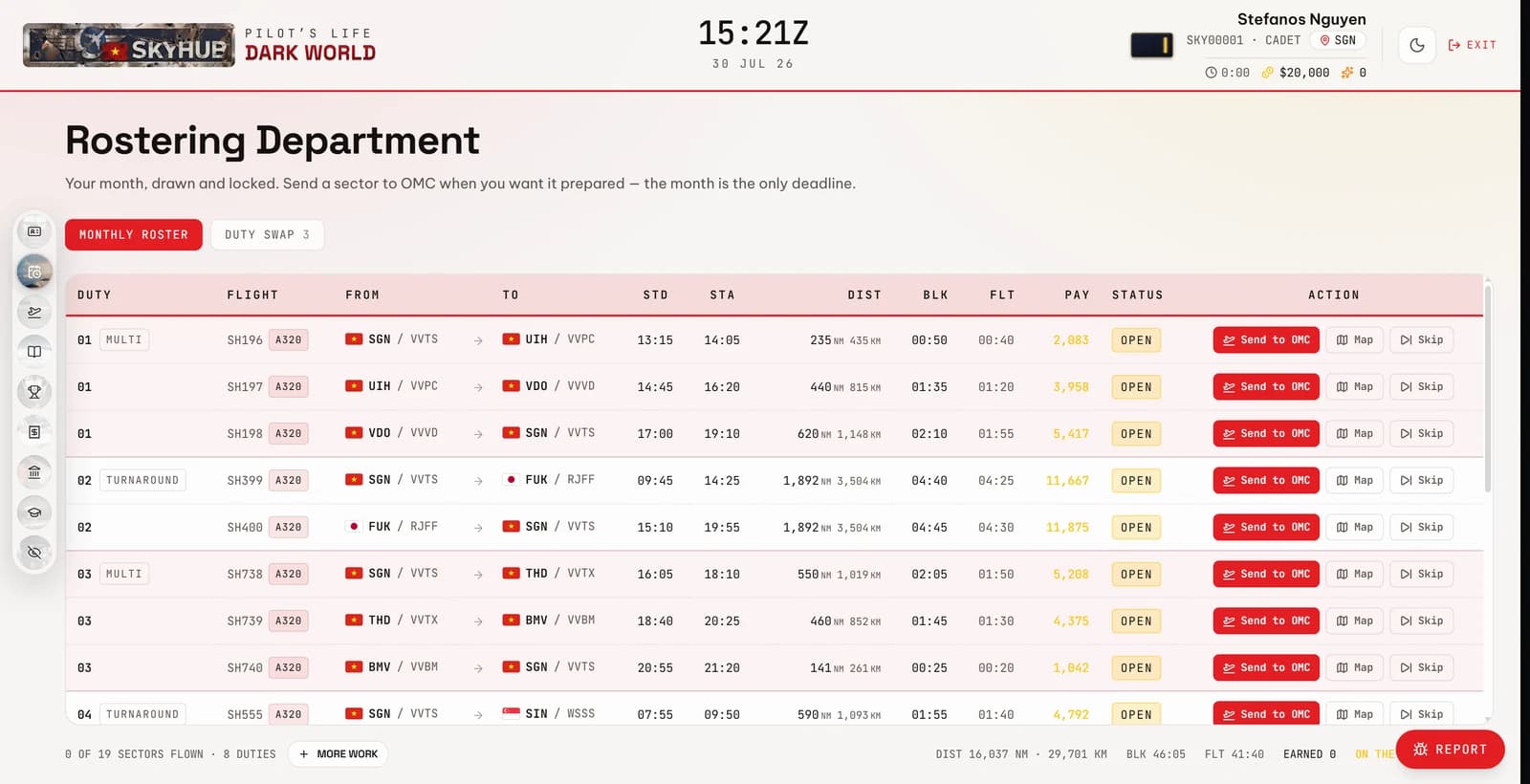
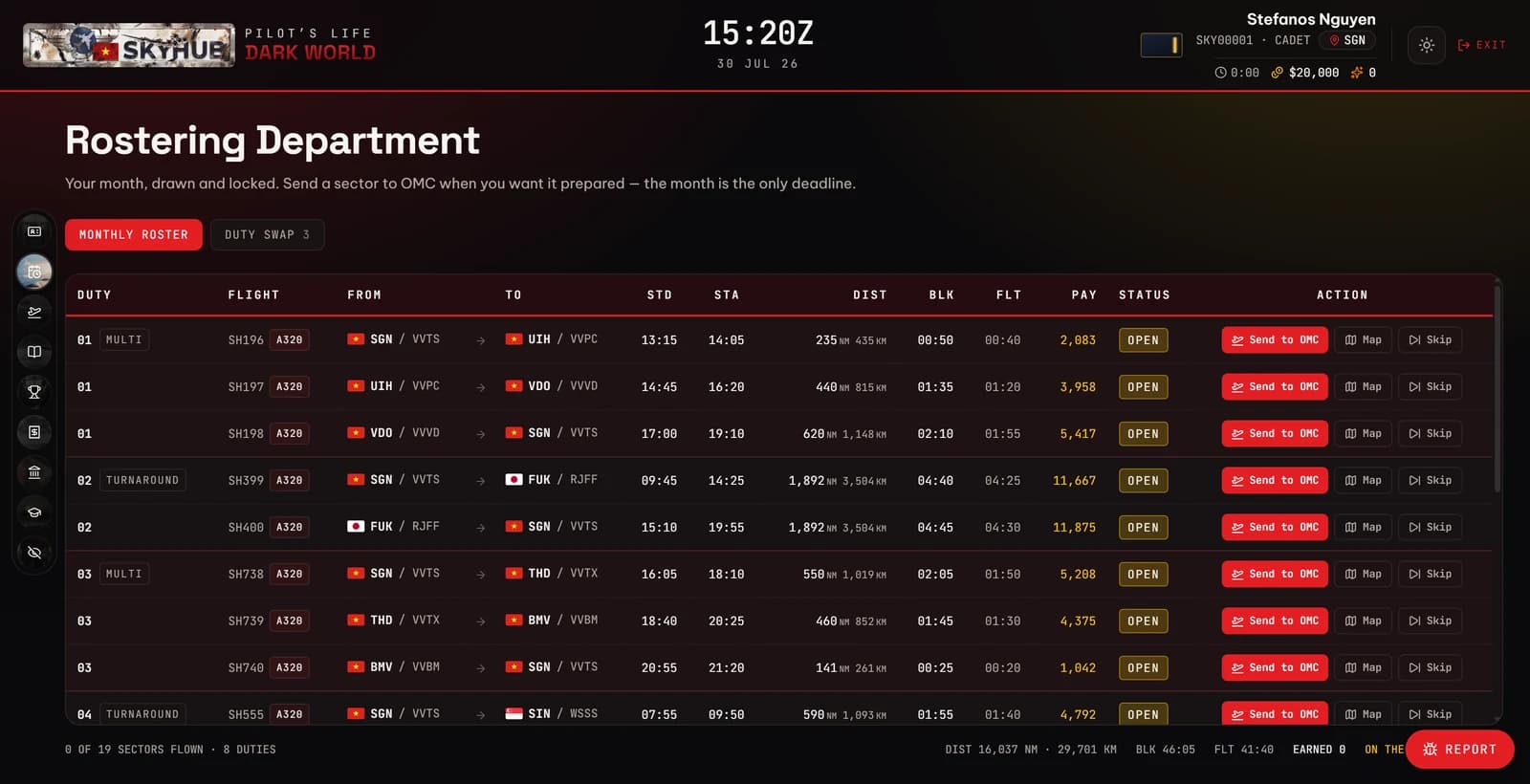
The unit is the duty
The sheet is stored and shown as sectors, one row per leg, because a leg is what you fly and what you are paid for. But the thing that was rostered is the duty: the chain of sectors drawn together, out and back, or down the coast and a night stop.
That is why the duty is the unit for everything done to a roster rather than on it. Re-cutting one leg of a three-sector day would leave a chain going nowhere.
A duty that will not fit inside a working day becomes a layover, and the sheet says so. The aeroplane is then where you left it, which is the other rule the sheet quietly enforces: the next duty starts where the last one ended.
The month is the deadline
Every sector carries a date, a scheduled off-block time and a scheduled arrival, because a roster without them is a to-do list. What the airline holds you to is the month.
That is the compromise this product makes with the fact that its pilots have jobs. A schedule you have to be at your desk for at 06:40 on a Tuesday is realism nobody asked for. A sheet of real flying you work through at your own pace is the same month without the alarm clock.
The duty you do not want
There will be one. The answer is a swap, and the important part is who you are asking: you do not trade with other pilots. You ask crewing.
Crewing says yes three times a month. The unit is the duty rather than the sector, and what comes back is different flying rather than an empty space — you are not being let off the sector, you are being moved.
The fourth time in a month you find someone else to ask, and how that conversation goes is not something the airline publishes.