


GETTING STARTED
What is a virtual airline, and how do you join one?
A plain explanation of virtual airlines, what joining one actually involves, what to look for in a good one, and what the words on their sign-up pages mean.
A virtual airline is a group of flight simulator pilots who fly to a shared structure — routes, schedules, ranks and a logbook that is kept for them rather than by them. The aeroplanes are the ones in your own simulator. What the virtual airline supplies is everything around the flying: somewhere to be going, a record of having gone, and other people doing the same.
They have existed for as long as desktop flight simulation has, and there are hundreds. This is what they have in common, what varies, and what to look at before you sign up.
What actually happens when you join one
The shape is broadly the same everywhere:
- You sign up and are given a pilot ID and a starting rank.
- You install a small desktop program — usually called an ACARS client — that watches your simulator while you fly.
- You pick or are assigned a route, fly it in your own simulator, and the client files a report at the end.
- That report becomes a logbook entry: hours, aircraft, times, and usually some measure of how well it went.
- Hours accumulate, rank increases, and you get access to longer routes or larger aircraft.
Everything beyond that is where they differ, and the differences are large.
The questions worth asking first
- Which simulators does it support? Check this before anything else. A virtual airline whose client does not work with the simulator you own is not a candidate, however good it looks.
- Is the logbook automatic or self-reported? Self-reported hours are quick to set up and mean approximately nothing. If you want the record to be worth having, you want the flying watched.
- Do you choose routes or are you assigned them? Free choice is more relaxed. Assignment is more like a job, and more likely to take you places you would not have chosen.
- Is it active? An empty virtual airline is a database. Look for recent flights and a populated leaderboard, not a founding date.
- What does it cost, and what is sold? Most are free. Some are paid. What matters more than the price is whether anything is sold that affects progression — an airline where cash buys rank is one where rank means nothing.
Free, paid, and what that changes
Most virtual airlines are free and run by volunteers, which is genuinely admirable and comes with the failure mode you would expect: they depend on a small number of people staying interested, and a lot of them quietly stop.
The paid ones are buying you, in principle, someone whose job it is to keep it running. Whether that is worth it depends entirely on the airline. What is worth checking either way is the refund position, and whether the purchase is one-off or recurring.
The thing to be wary of is not the price. It is a shop that sells progression. If hours, rank or aircraft access can be bought, then the logbook is a receipt rather than a record.
Where SkyHub sits
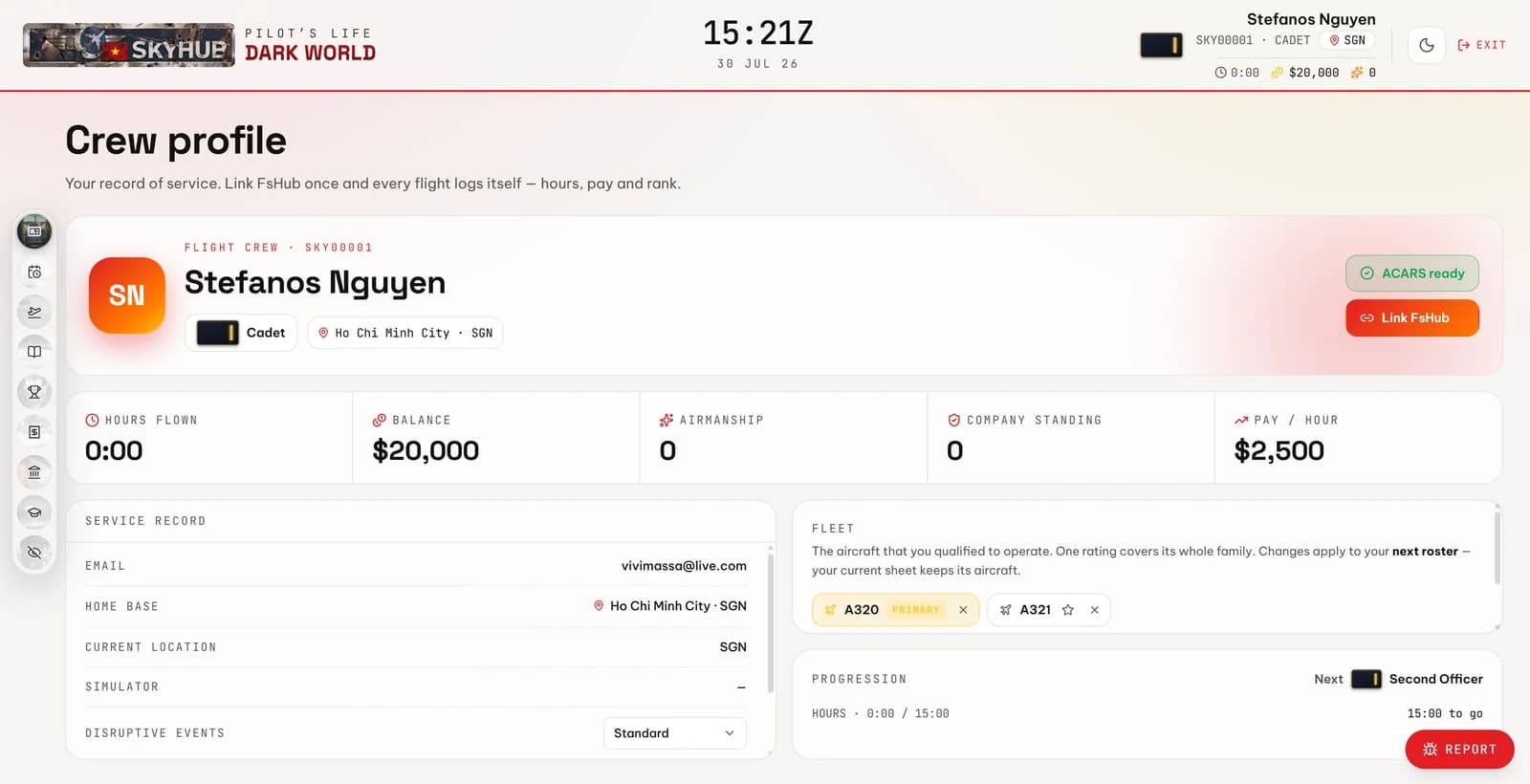
SkyHub is a virtual airline with a career economy attached, for Microsoft Flight Simulator 2020 and 2024. It is a one-off purchase with a fourteen-day refund window, and nothing else in the game is ever sold for real money — rank is gated on flown hours and paid for with money you earned in the game.
It is more structured than most: you are issued a monthly roster rather than picking routes, the aircraft has to be where you last parked it, and every sector is graded on how it was flown.
If you would rather start somewhere free and less demanding, that is a sensible way to find out whether this hobby suits you, and there are good ones. Come back when you want the hours to count for something.