
FLIGHT DATA MONITORING
How a landing is graded
The touchdown thresholds, what each one costs you, and the twenty-odd other things the recorder was watching while you were busy flaring.
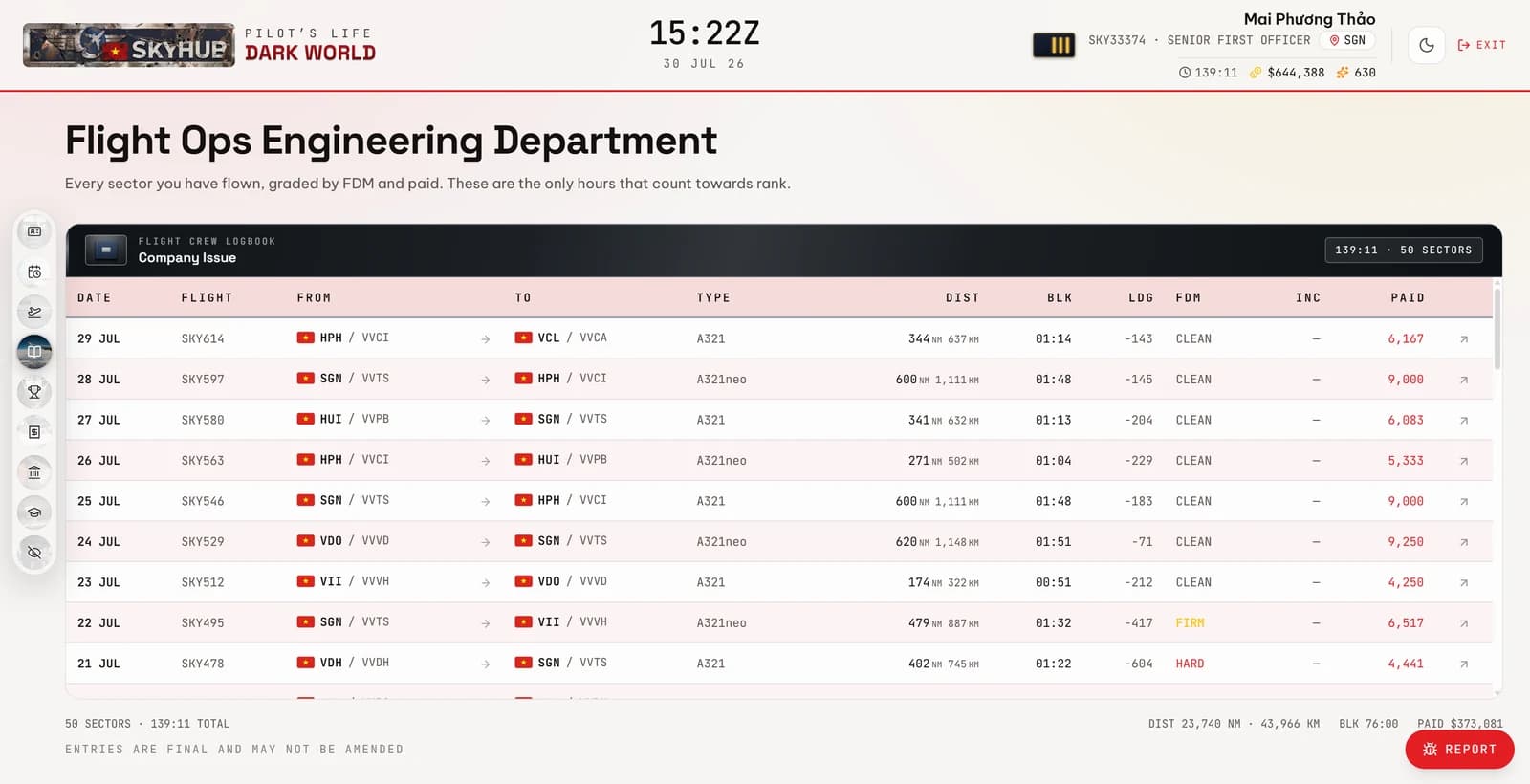
Every sector you fly at SkyHub is recorded by the Companion App and graded by the server against what the aeroplane actually did. Not what you report, and not how it felt — the recorded track. This is what that grading consists of.
The short version: the touchdown rate is the part that costs you money, and everything else is the part that tells you whether you are actually getting better.
The touchdown, and what it costs
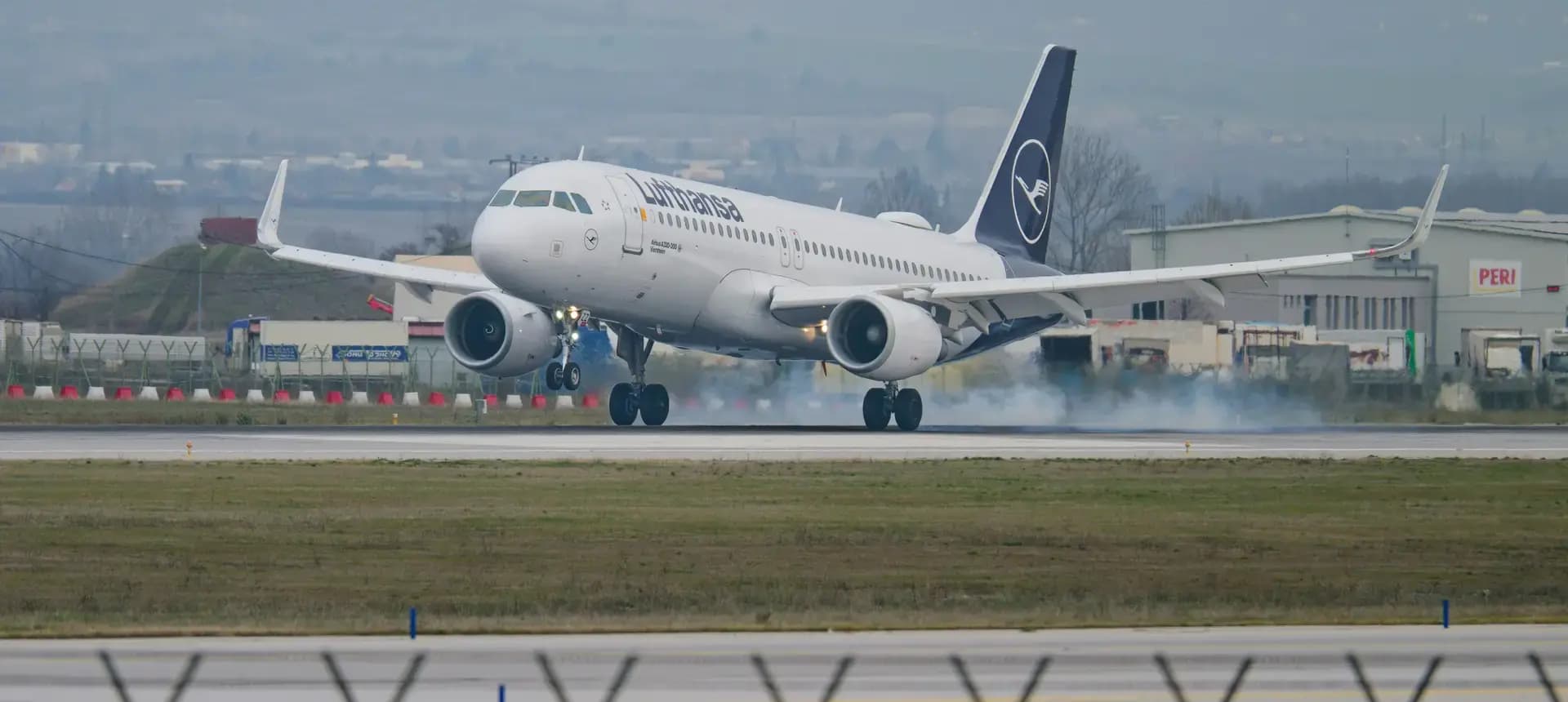
Landings fall into four bands, measured on the vertical speed at the moment of touchdown. The thresholds are absolute and they do not move with aircraft type, weight or weather:
- Clean — 400 fpm or less. No penalty.
- Firm — over 400 fpm. 15% off that sector’s pay.
- Hard — over 600 fpm. 35% off.
- Severe — over 900 fpm. 60% off.
There is one rule about those penalties that matters more than the numbers: a bad landing never costs more than that one flight’s pay. It does not cascade. It does not follow you into next month, it does not touch your hours, and it cannot compound with anything else into a spiral you have to dig out of. You arrive firm, you get paid less for that sector, and the next sector starts clean.
That is a deliberate design decision rather than a technical limitation. A career economy that punishes a bad night by making the next twenty nights worse is a career economy nobody keeps playing.
Passenger comfort
The comfort section grades the flight from the cabin’s point of view — the things a hundred and seventy people in the back would notice. Each check passes, warns or fails, and the section score is the proportion that passed.
- Maximum bank angle — 35° or less.
- Maximum pitch angle — 20° or less.
- Maximum G-load — 2.5 g or less. Minimum G-load — 0.5 g or more.
- Maximum climb rate — 4,000 fpm or less.
- Roll rate — 15°/s or less.
- Overspeed and stall — never. These are the only two comfort checks that fail outright rather than warn.
The climb-rate limit is worth explaining, because the obvious number is the wrong one. It used to be 3,000 fpm, and a lightly loaded narrowbody on a short sector passes 3,000 fpm in the initial climb as a matter of routine — that is simply what the aeroplane does with two working engines and no payload to speak of. Every honest short sector was collecting a comfort warning for flying normally, which teaches pilots to ignore the section entirely. 4,000 leaves ordinary performance alone and still catches a sustained rocket climb with the nose high enough to press people into their seats, which is the thing a passenger actually feels.
The descent rate is judged against its own altitude
Descent is the one comfort check that is not a single number, because a descent’s altitude is the whole difference between routine and dangerous. 3,000 fpm passing FL200 is a normal descent; 3,000 fpm at 1,500 ft above the ground is an accident report. So the ceiling moves with the height it happened at:
- Above 10,000 ft — 4,000 fpm.
- Below 10,000 ft — 3,000 fpm.
- Below 2,000 ft above ground level — 2,000 fpm.
The report quotes the rate that came closest to its own band’s limit, and the limit it was measured against — so a row reading "2,400 fpm, limit ≤ 3,000" tells you both what you did and which rule you were being held to.
Technique
The technique section is the handling one: it grades the flight as a pilot would be graded on a line check, from the rotation to the touchdown zone.
- Rotation speed — Vr ±5 kt. Rotation rate — 2.5 to 3.5°/s.
- Climb speed — 250 KIAS below 10,000 ft, with a 5% tolerance.
- Stable approach — stable by 1,000 ft or higher.
- Approach speed — Vapp +5/−0.
- Final descent — 1,000 fpm or less.
- Gear down by 1,000 ft. Speedbrake armed. Landing flaps appropriate to the type.
- Touchdown zone — within 1,500 ft of the threshold.
The 5% tolerance on climb speed exists for the same reason the climb-rate limit moved. 250 below 10,000 is the real rule and it stays the rule, but this was once graded to the knot, against a speed the pilot is holding by hand or watching the autothrust chase through a wind gradient. A momentary 252 is a needle moving, not a speeding offence, and marking it as one taught pilots the check was noise. 5% is enough room for the overshoot after a level-off and nowhere near enough to hide a pilot who simply never slowed down.
What the recorder will not accuse you of
Two checks pass when the recording cannot answer them, rather than warning. If your add-on does not drive the speedbrake armed flag, or the type has no flap quadrant to read, the report shows what it saw and does not grade it.
This is the rule the whole grading system is built on: a warning is an accusation, and an accusation we cannot support is worse than a missing row. The report would rather tell you less than tell you something untrue about your flying.
A go-around is treated the same way, for a different reason. It appears on the report when it happens and it always passes — a go-around is airmanship done right, and it is never a mark-down. Whatever led to it is the event system’s business, not the grading table’s. A bounce, on the other hand, is technique, and reads as one.
Why grade any of this
Because an hour is not an achievement. Any flight simulator will let you sit at cruise and accumulate time, and a logbook that only counts hours rewards exactly that.
What the grading gives you is a reason to fly the sector properly when nobody is watching and nothing is at stake — and, over a few months, a record that shows whether your hand-flying is actually improving or whether you have just done the same mediocre approach two hundred times.
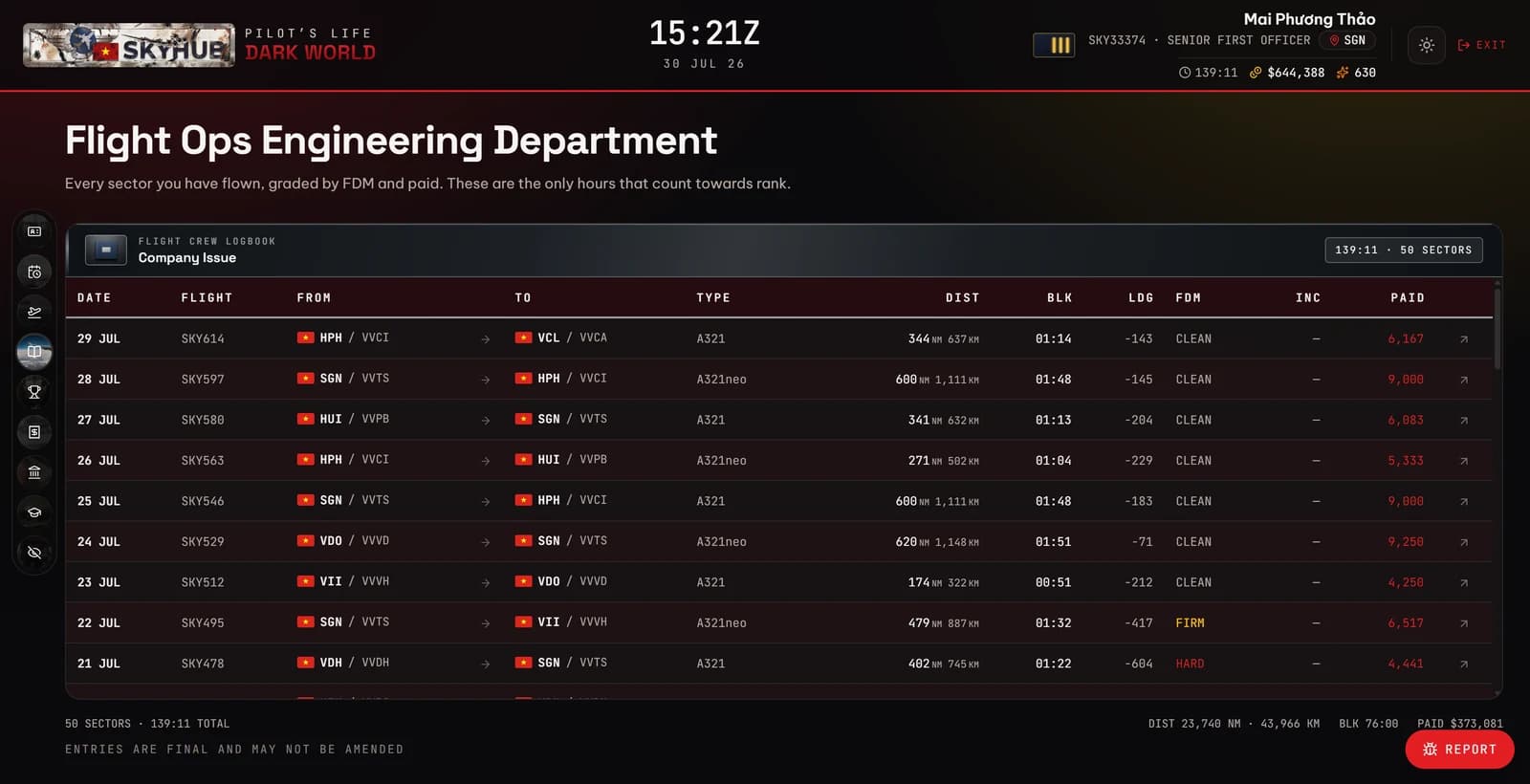
Every sector’s report is kept. Entries are final and cannot be amended.